The Anger Run and Green Whales

My favorite exercise of emotional release is the Anger Run. This is usually the first exercise in the series, because it tires the actor quickly. It’s very hard to stay energetically angry for a whole scene.

Two actors involved in a particular scene speak their lines to each other with the help of their under-readers, but instead of speaking them as the characters, they speak them with the highest level of anger than they can muster up. This is difficult. Most actors, on their first attempt, “act” angry, instead of “being” angry. I have tried this myself, and I know that the difference can be confusing. As a trained actor, you are used to search for a motivation. Why are you angry? Where does your anger come from?

It doesn’t matter. The Anger Run is simply about using up as much energy as you can, and that energy comes from anger. Brian Astbury gives only three rules to obey during an anger run, for safety’s sake:

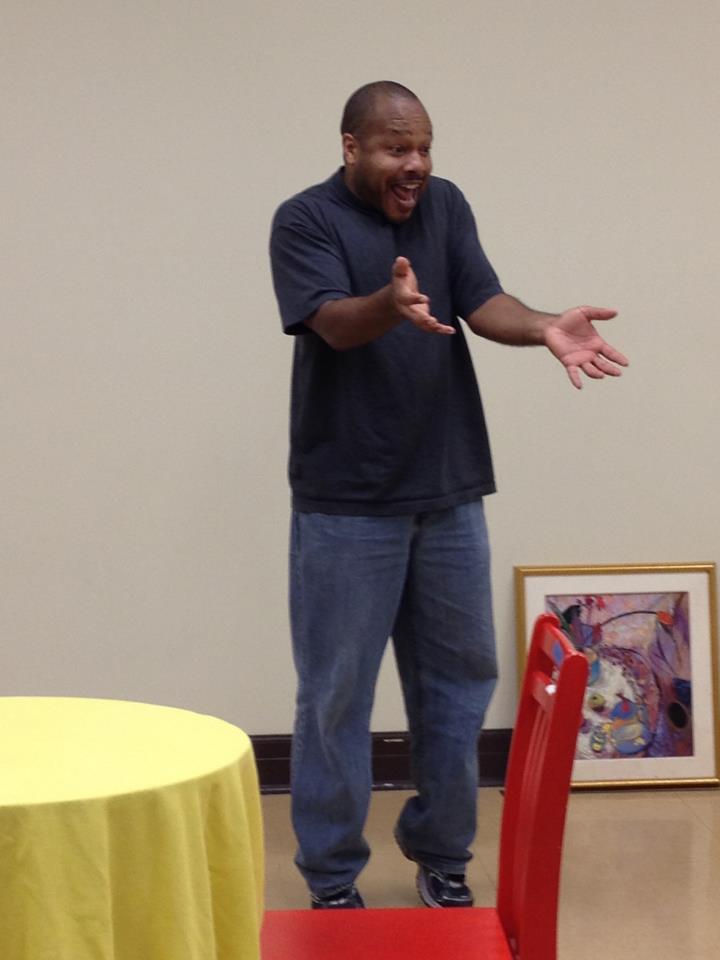
Sara Luna during an anger run. Photo Jenn Poret
Michael Wayne Rice during an anger run. Photo Jenn Poret


– no handling of any piece of furniture of prop

– no touching of another actor

– no kicking or punching floors or walls


In rehearsals for Green Whales we did anger runs in the first week, and then we did them again about four weeks later, when we needed a boost, a fresh look at a stale scene. I find Anger Runs quite funny, because the characters in the scene are usually not written to be angry.

Below is a short excerpt from the script by Lia Romeo. Read it first, then watch the video in which actors Gloria McDonald (playing Karen) and Keith Marshall (playing Ian) do the same scene as an Anger Run.

***

IAN: I really enjoy spending time with you – I mean, you’re smart, and you’re funny, and you’re fun to be around -

KAREN: Okay, but you’re not . . .

IAN: What?

KAREN: You’re not attracted to me.

IAN: I –

KAREN: It’s all right. Guys . . . usually aren’t.

IAN: Actually, I can hardly let myself look at you.

KAREN: Oh. (Beat.) Wait, do you mean that in a good way or a bad way?

IAN: In a good way. Or . . . a bad way. Or a good way for you, but a bad way for me – what I mean is you’re gorgeous.

 ***

As you can tell, Gloria and Keith are already tired, since this Anger Run came toward the end of a long rehearsal. Both of them were panting by the last line. And the immediate next thing to do is to do the scene again, this time as Karen and Ian – the characters – and see if any new or truthful connections take place. Of course, there were many.

I invite you to experience the results of Under-Reading and Emotional Release live on stage, especially now that you know so much of the theory behind it.

Green Whales performs at the Historic Hoover Theatre, 1635 Park Avenue in San Jose, through February 25th. For tickets, call (408) 493-0783 or visit Renegade Theatre Experiment online.

Posted in Under-Reading | Tagged , , , , , , | Comments Off

Emotional Release and Green Whales

The second part of Brian Astbury’s approach is what he calls “emotional release”. It is a series of physical exercises that basically get your body tired, such that your emotions are allowed to come out. Under-reading goes hand-in-hand with emotional release. You can use under-reading alone, which is why I was able to use it in auditions, but you cannot perform any emotional release exercises without under-reading. Let me explain.

Emotional Release

Your Left Brain takes care of you by giving you defenses. Defenses are unconscious reactions that protect you and your body in any given situation – from extreme emergencies to everyday encounters. They protect you from your emotions, which can often be too much to handle, by placing you in a state of fight, flight or freeze. Some common defenses: shallow breathing, tense jaws and shoulders, stiffness, strangulated voice, swallowing, crossing arms, tapping, the list is endless.

Now, if you’re an actor, defenses can be an impediment. If any emotion sets off a defense meant to protect you from said emotion, how are you, the actor, supposed to connect emotionally with your character? I wish there was a way to instruct the Left Brain that some emotions are good, really good, and you want to experience them fully. But there isn’t. So when a character’s emotions reach out from inside your core, trying to connect with your emotions and create beauty, your defenses put up a wall, slam the door and throw away the key. You, the actor, are blocked.

I am not denigrating our defenses. We need them. A really good example that Astbury provides is coping with the loss of a loved one. When the most important person in your life leaves you, or dies, a common response is to become emotionally numb for a while. Until you are ready to deal with the loss. This is your body’s way to help you survive, because if you took in all of the emotion associated with the loss right when it happens, the pain of it might just kill you.

Sara Luna and Michael Wayne Rice during an emotional release exercise with under-readers Keith Marshall and Gloria McDonald. Photo Jenn Poret

The exercises developed by Brian Astbury over years of trial and error with acting students are a way to stop your Left Brain from creating defenses. If you’re physically exhausted, then your body cannot put up defenses. Pretty simple. Your Right Brain finds the key, unlocks the door, breaks down the wall, and your character’s emotions embrace you with warmth and understanding.

To be able to lead an actor through emotional-release exercises takes a lot of experience. I am still learning, researching and building my experience. So my attempts to lead the cast of Green Whales through these exercises was tentative, at its best. What I would like to do is teach a course in which I can explore these exercises with acting students – the most willing group of people I know.

That said, what I learned in rehearsals is that each actor has a different threshold of physical exhaustion that cannot be planned for. As a director, I need to be prepared for anything and take each actor’s experience as a completely new event.

In the next post, I talk about the Anger Run, my favorite emotional release exercise.

Posted in Under-Reading | Tagged , , , , , , | Comments Off